

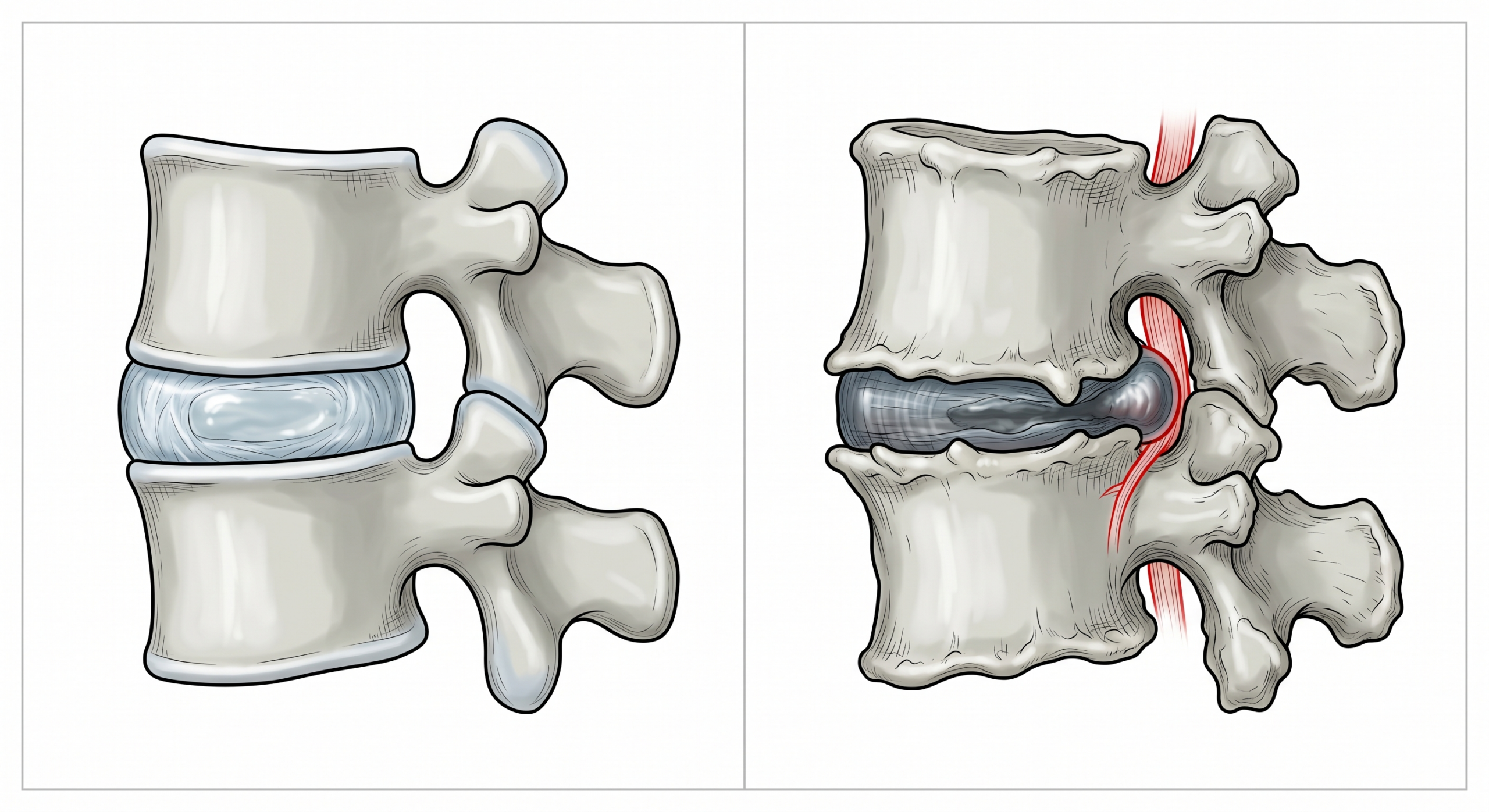
The discs in your spine work harder than most people realize. They take the weight of every step you take, every box you lift, and every hour you spend at a desk. They also lose water overnight and refill it during the day. Most of their food and water comes from movement, not blood. That’s the main reason we recommend chiropractic and acupuncture for back problems. Discs need healthy movement to stay strong, and those treatments are built around giving them that movement.
This is the guide I wish more patients had read before they ended up in my office with a disc problem.
What Discs Need to Stay Healthy
Three things keep your discs healthy over the long haul:
Regular movement. Discs need to move to swap water in and out. When your spine bends and shifts during the day, fresh water moves in and old waste moves out. Movement is how the discs breathe.
Good posture when you’re carrying weight. Discs handle pressure well when your back is straight. They handle pressure poorly when your back is bent forward, especially when you’re lifting something heavy.
Breaks from sitting still. Sitting is the big one. When you sit for hours without moving, the discs dry out and don’t get a chance to refill. The fix is simple: stand up and move every half hour or so.
Almost everything in this guide comes back to those three ideas.
The Sitting Problem
Sitting is the biggest cause of disc problems I see. Not because sitting is dangerous on its own, but because most people sit for 8 to 12 hours a day without breaks.
Sitting puts more pressure on the discs than standing. And most people don’t sit up straight, they lean forward, which puts uneven pressure on the discs and squeezes the back side of them more than the front. That’s where most disc bulges and herniations happen. After hours of this, the disc is dried out, the nearby muscles are weak, and the joints above and below the disc get stiff.
The fix isn’t a fancy office chair. It’s getting up often. Every 30 to 45 minutes, stand up, walk for a minute, stretch, then sit back down. How often you take a break matters more than how long the break is. If your job won’t let you do that, a sit-stand desk that lets you switch positions every half hour is the next best thing.
Lifting the Right Way
You’ve heard “lift with your legs, not your back” a hundred times. The advice is right. But most people don’t actually do it. The body wants to bend at the back because it’s faster and feels easier. Doing it the right way takes practice.
The basics:
Keep the load close to your body. A 30-pound box held close to your chest puts less stress on your spine than a 10-pound box held at arm’s length.
Bend at your hips and knees, not your back. Your hips and knees are built to bend under weight. Your back isn’t.
Keep your back straight. A small forward lean is fine. Rounding your back forward is what causes injuries.
Don’t twist while lifting. Pick up the box, take a step, then turn. Don’t twist with the weight in your hands.
Use your breath. Breathe out as you lift the heaviest part. Holding your breath is okay for a single heavy lift, but it raises your blood pressure.
If you lift anything heavy on a regular basis (kids, groceries, weights at the gym), this stuff adds up. Done right for years, your discs stay much healthier. Done wrong, even smaller weights cause problems over time.
Walking: The Best Thing You Can Do for Your Discs
Walking is the single best daily habit for disc health. Twenty to thirty minutes a day, every day, makes a real difference. Here’s why.
When you walk, your weight shifts from one leg to the other in a steady rhythm. That gentle push and release squeezes the discs and lets them fill with fresh water at the same time. Discs actually soak up water while you walk, and dry out when you sit too long.
Walking also wakes up the deep muscles that hold your spine steady. These muscles get weak in people who sit all day. Walking strengthens them without you even thinking about it.
Walking also pumps more blood to the muscles and ligaments around your spine. That helps your body heal faster if you’re injured. And it lowers stress, which keeps your muscles from staying tight.
You don’t need to walk fast. You don’t need special gear. The amount that matters is the time, not the speed. Twenty minutes a day beats sixty minutes once a week.
Sleep Position
Discs rehydrate overnight. That’s why you’re slightly taller in the morning than at night, measurable, around half an inch. The position you sleep in affects how well that rehydration happens.
Side sleeping with a pillow between your knees. Generally the best position for spinal alignment. The pillow keeps the top leg from collapsing forward, which would twist the pelvis and load the lumbar discs.
Back sleeping with a pillow under the knees. Also excellent. The bent knees take pressure off the lumbar spine.
Stomach sleeping. Worst for the neck because you have to turn your head to breathe, which holds the neck in rotation for hours. If you must stomach sleep, use the thinnest pillow possible (or none) and try to transition out of the habit.
A medium-firm mattress that supports your spine without sinking is the best general recommendation. Soft mattresses let the heavier parts of your body (hips, shoulders) sink in and pull the spine into bad positions.
Hydration and Nutrition
Discs are 70 to 80 percent water by volume. Adequate daily hydration is a basic requirement. The body prioritizes hydration for other tissues if water is limited, and the discs are downstream of that priority.
Most adults need about half their body weight in ounces of water per day. A 180-pound person needs roughly 90 ounces. Coffee, alcohol, and soda don’t count toward this because they’re net dehydrating.
Beyond hydration, anti-inflammatory eating supports the disc tissue and the surrounding structures. The basics: more fish, leafy greens, berries, nuts, olive oil. Fewer processed foods, fried foods, excess sugar, and excess alcohol. Same eating pattern that reduces cardiovascular risk also reduces musculoskeletal pain risk.
Posture Under Real Loads
A lot of posture advice focuses on standing still in a perfect position. That’s not where most posture problems happen. The problems happen when you’re under real load, sitting at a screen, looking at a phone, carrying a heavy bag, holding a child.
Some real-world cues:
- When using your phone, hold it at eye level instead of looking down at your lap
- When sitting, your hips should be slightly higher than your knees, not lower
- When standing for long periods, shift your weight side to side and slowly bend through your knees occasionally
- When carrying anything heavy on one side (groceries, work bag, child), switch sides regularly
- When working at a screen, the top of your monitor should be at eye level
None of these are dramatic. Done consistently for years, they’re the difference between a healthy spine at 50 and a spine that’s hurting.
The Long View
Disc degeneration is partly genetic and partly mechanical. You can’t change the genetic part. You can absolutely change the mechanical part.
Patients who maintain consistent movement habits, lift with reasonable mechanics, manage their sitting time, and stay hydrated tend to have spines that work well into their 60s, 70s, and beyond. Patients who don’t tend to develop chronic disc problems that limit them by their 40s.
The choices compound. Most of them are small individually.
Frequently Asked Questions
Do I need to do special exercises for disc health?
Walking does most of the work. Beyond that, basic core stability exercises (plank, side plank, glute bridge, bird dog) are useful for general spinal support. You don’t need anything elaborate.
What about inversion tables?
Inversion tables can provide short-term disc decompression for some patients. The evidence for long-term benefit is mixed. Reasonable to try if you find them comfortable. Not necessary, and definitely not a substitute for the daily habits in this guide.
Can supplements help my discs?
The evidence is limited. Glucosamine and chondroitin have been studied extensively and the results are modest at best. Vitamin D and magnesium correct deficiencies that affect general musculoskeletal health. Beyond that, the basics of hydration and anti-inflammatory eating matter more than any supplement.
How important is mattress quality?
Important enough that a bad mattress can drive chronic back pain on its own. A medium-firm mattress (think 6 to 7 on a 10-point firmness scale) suits most people. Replace mattresses every 8 to 10 years.
When should I see a chiropractor for prevention?
If you have a desk job, lift regularly at work, have a history of back pain, or simply want a baseline assessment of how your spine is moving, a chiropractic exam can identify restrictions before they cause symptoms. Periodic visits (every 4 to 6 weeks for some patients, every few months for others) often keep small issues from becoming big ones.
Get Started
Most disc problems are preventable. The daily choices in this guide are what separates patients who keep their spines healthy for decades from patients who don’t.
If you’d like a baseline assessment of where your spine is now and what specific habits would help most, we see patients from West Omaha, Millard, Elkhorn, and the broader Omaha area.
Book your visit online or call (402) 330-8600.
Related Reading
- Walking for Back Pain: How a Daily Walk Helps Your Spine — deeper dive on why walking is the single best disc-health habit
- Tech Neck: How Phones and Laptops Are Wrecking Your Spine — neck-specific disc and posture content
- Maintaining Good Posture and Spinal Health — broader posture habits
- Pinched Nerve: Causes, Treatment, and When to See a Chiropractor — what happens when discs press on nerves
- Can a Chiropractor Help with Sciatica? — the most common disc-related condition we treat
About the Author
Dr. Dane Becker found chiropractic the way a lot of his patients do: through pain. A weightlifting injury in college left him with such intense back and chest pain he thought he was having a heart attack. His trainer sent him to a local chiropractor, the pain backed off almost immediately, and he was hooked.
Since 2008 he’s been practicing in West Omaha, serving patients from Millard, Elkhorn, and the broader Omaha area. He’s trained in sports injuries through postgraduate CCSP education and a specialist in whiplash and auto injury cases. He’s worked with numerous NFL, NBA, and MLB players, plus college and pro female athletes. Becker Chiropractic & Acupuncture is a multi-year Best of Omaha winner. When he’s not at the clinic, he’s with his three kids (Colson and twins Lyla and Liam), and the family is happiest on a beach.